Table of Contents
The Most Impressive Engineering Structures in the World: Monuments to Human Ingenuity and Ambition
Throughout history, humanity has pushed the boundaries of what’s physically possible, creating structures that inspire awe, serve vital functions, and stand as testaments to our collective ingenuity. These engineering marvels—from ancient walls that have endured millennia to modern skyscrapers piercing clouds—represent far more than steel, concrete, and stone. They embody the vision of architects and engineers who dared to imagine the impossible, the determination of workers who brought those visions to life, and the problem-solving brilliance required to overcome seemingly insurmountable obstacles.
Engineering structures tell stories about the civilizations that built them: their values, their technological capabilities, their ambitions, and their understanding of the natural world. They transform landscapes, connect separated regions, harness natural forces, and sometimes simply demonstrate that humans can build something beautiful and permanent in an impermanent world. These monuments to human achievement continue inspiring us because they represent not just technical accomplishment but the fundamental human drive to create, to connect, and to leave something meaningful for future generations.
This comprehensive exploration examines the world’s most impressive engineering structures, analyzing not just their physical characteristics but the challenges overcome during construction, the innovations they pioneered, their impact on society, and what makes them genuinely extraordinary examples of human capability.
Burj Khalifa: Redefining the Limits of Vertical Construction
Dubai, United Arab Emirates
Rising 2,717 feet (828 meters) above the Dubai desert, the Burj Khalifa doesn’t just claim the title of world’s tallest building—it obliterates previous height records. When completed in 2010, it stood nearly 200 feet taller than its nearest competitor, claiming not just the tallest building crown but also the tallest free-standing structure, highest occupied floor, and highest outdoor observation deck. The tower’s 163 floors contain residences, corporate offices, restaurants, and the Armani Hotel, making it a vertical city rather than merely a building.
Engineering Challenges and Solutions
Building to such unprecedented heights required solving problems no structure had previously faced. At extreme heights, wind forces become exponentially more powerful and complex. The Burj Khalifa’s distinctive Y-shaped floor plan, inspired by the regional Hymenocallis flower, isn’t merely aesthetic—it reduces wind forces by confusing airflow and preventing organized vortex formation that could set up destructive oscillations. Wind tunnel testing involving over 40 different studies refined the design to ensure stability while minimizing material use.
Structural system innovations were equally critical. The tower uses a “buttressed core” design where a central hexagonal core connects to three wing structures, each buttressed by its own concrete core. As the building rises, these wings step back in a spiraling pattern, reducing mass and wind resistance at higher elevations while maintaining structural integrity. This system distributes loads efficiently while providing exceptional resistance to twisting forces that become pronounced in supertall structures.
The concrete mixture itself represented a materials science achievement. Desert temperatures regularly exceed 100°F (38°C), and pouring concrete in such heat risks premature curing that weakens the structure. Engineers developed a special concrete mix incorporating ice and chilled water, poured primarily at night when temperatures dropped. The concrete included additives that delayed setting time, allowing proper placement before hardening. Final concrete strength exceeded 14,500 psi (pounds per square inch)—roughly three times stronger than typical concrete—necessary to support the enormous compressive loads at the base of such a tall structure.
Foundation engineering required anchoring the tower to bedrock through 192 reinforced concrete piles driven over 160 feet (50 meters) deep. These piles transfer the building’s enormous weight—estimated at over 500,000 tons—to stable geological layers capable of supporting such loads. The foundation includes a massive concrete and steel raft 3.7 meters thick supporting the entire structure.
The vertical transportation system pushes elevator technology limits. The building contains 57 elevators and 8 escalators, with the fastest elevators traveling at 33 feet (10 meters) per second—requiring advanced systems to prevent passenger discomfort from pressure changes and acceleration forces. Double-deck elevators maximize capacity within limited shaft space, essential in supertall buildings where elevator shafts consume substantial floor area.
Cultural and Economic Impact
Beyond engineering achievement, the Burj Khalifa represents Dubai’s transformation from regional trading center to global metropolis. The tower anchors Downtown Dubai, a massive development including the Dubai Mall and choreographed fountains, becoming the centerpiece of the city’s international identity. Its completion demonstrated that Middle Eastern cities could compete with traditional centers of architectural innovation in New York, Hong Kong, and Shanghai.
The structure influenced global architecture, proving supertall construction feasible in challenging climates and accelerating the race toward kilometer-high buildings. Current proposals in Saudi Arabia and China aim to surpass the Burj Khalifa, extending the boundaries it established.
The Great Wall of China: Ancient Engineering on an Unprecedented Scale
Northern China
Stretching approximately 13,170 miles (21,196 kilometers) across mountains, plateaus, and deserts, the Great Wall of China represents the largest construction project in human history. Built incrementally over more than two millennia, with major construction periods during the Qin Dynasty (221-206 BCE) and Ming Dynasty (1368-1644 CE), the wall showcases how persistent effort and organizational capability can achieve what seems impossible through individual projects.
Construction Across Diverse Terrain
The Great Wall’s engineering brilliance lies not in technological sophistication but in adapting construction to wildly varying geography and available materials. In mountainous regions, builders positioned walls along ridge lines, using natural topography for defensive advantage while minimizing required material. Steep slopes necessitated strong foundations and drainage systems preventing water accumulation that would undermine walls.
Material selection varied by region and era. Early sections used rammed earth—layers of soil, gravel, and sand compacted through repeated pounding—creating surprisingly durable walls still visible today. Ming Dynasty sections employed fired bricks and cut stone blocks, providing superior durability but requiring massive quarrying, brick-firing, and transportation efforts. In desert regions where neither stone nor suitable soil existed, builders used whatever materials were available, including bundles of willow branches.
Labor organization represented an administrative and logistical achievement as impressive as the physical construction. At peak periods, hundreds of thousands of workers—soldiers, peasants, and prisoners—labored simultaneously on different sections. Coordinating such massive workforces required sophisticated supply chains delivering food, tools, and materials across vast distances to remote construction sites.
The wall incorporated defensive engineering features refined over centuries: watchtowers positioned at regular intervals for communication via smoke signals or flags, garrison stations housing troops, beacon towers on high points for long-distance signaling, and strategic passes fortified with additional walls and gates creating kill zones where defenders held overwhelming advantages.
Engineering Durability
The Great Wall’s survival through millennia of weathering, earthquakes, and human activity testifies to sound engineering principles. Proper foundations, drainage systems preventing water damage, and quality materials in critical sections allowed the wall to endure where poorly constructed segments crumbled. Modern conservation efforts focus on the best-preserved sections, particularly Ming Dynasty brick construction, while substantial portions have deteriorated severely or disappeared entirely.
The wall demonstrates that engineering greatness doesn’t require advanced technology—it requires understanding materials and environment, adapting designs to local conditions, and executing construction competently at massive scale.
The Channel Tunnel: Connecting Nations Beneath the Sea
United Kingdom and France
The Channel Tunnel, or “Chunnel,” connects Folkestone, England, with Coquelles, France, through 31.4 miles (50.5 kilometers) of tunnel beneath the English Channel, including 23.5 miles (37.9 kilometers) underwater—making it one of the longest undersea tunnels globally. Opened in 1994 after six years of construction, the tunnel realizes a vision discussed for over two centuries but deemed impossible until modern tunnel boring technology matured.
Geological and Engineering Obstacles
Digging beneath one of the world’s busiest shipping lanes while managing water pressure, variable geology, and international coordination presented extraordinary challenges. Engineers selected a route through a layer of chalk marl—relatively impermeable sedimentary rock providing stable tunneling conditions while minimizing water infiltration. This geological layer, 40-50 meters below the seabed, offered the optimal balance of depth (sufficient to prevent seabed collapse) and engineering feasibility.
Tunnel boring machines (TBMs) revolutionized the project’s feasibility. These massive machines, over 400 feet long weighing thousands of tons, excavated the tunnel while simultaneously installing concrete lining segments. Eleven TBMs worked simultaneously from both English and French sides, excavating three tunnels: two 25-foot (7.6-meter) diameter rail tunnels and one 16-foot (4.8-meter) service tunnel for maintenance and emergency evacuation. The machines advanced roughly 250 feet (75 meters) per day through favorable geology, though difficult sections slowed progress considerably.
Breakthrough precision demanded extraordinary surveying accuracy. Tunnels starting from opposite coasts needed to meet in the middle with millimeter precision despite traveling miles through rock without direct line of sight. Engineers used laser-based guidance systems, gyroscopic surveying instruments, and precise satellite positioning to maintain proper trajectory. When English and French crews finally met, the alignment error was less than 2 inches (5 centimeters)—a remarkable achievement given the distances and challenging conditions.
Water management remained a constant concern despite selecting relatively impermeable chalk. Groundwater seepage required continuous pumping, and sections where TBMs encountered fissures or more permeable rock demanded immediate sealing and reinforcement. The service tunnel included infrastructure for pumping water from rail tunnels, ensuring they remained dry for high-speed train operation.
Safety and Operational Systems
The Channel Tunnel incorporates extensive safety systems addressing fire, collision, and medical emergencies in an environment where evacuation is uniquely challenging. The service tunnel provides escape routes, with cross-passages connecting to rail tunnels every 375 meters. Sophisticated ventilation systems can reverse airflow, pulling smoke away from evacuating passengers. Fire detection and suppression systems, emergency lighting, communication networks, and designated rescue areas provide multiple safety layers.
High-speed rail infrastructure allows Eurostar passenger trains to traverse the tunnel in approximately 20 minutes at speeds up to 100 mph (160 km/h), while shuttle trains transport vehicles between terminals. The tunnel transformed travel between Britain and continental Europe, shifting market share from airlines and ferries while enabling greater economic integration.
The Channel Tunnel demonstrates how modern engineering combines multiple disciplines—geology, civil engineering, mechanical systems, electronics, and project management—to achieve what previous generations considered fantasy.
Panama Canal: Engineering Trade Routes and Reshaping Global Commerce
Panama
The Panama Canal ranks among history’s most impactful engineering projects, cutting 8,000 miles off the sea journey between Atlantic and Pacific Oceans by providing a 51-mile (82-kilometer) shortcut through the Central American isthmus. Completed in 1914 after one of the most difficult construction projects ever attempted, the canal fundamentally altered global trade patterns, naval strategy, and geopolitics.
A Vision Nearly Abandoned
French engineer Ferdinand de Lesseps, famous for constructing the Suez Canal, initially attempted building a sea-level canal across Panama in 1881. The effort failed catastrophically, costing over 22,000 lives to disease—primarily yellow fever and malaria—and bankrupting the French company. The tropical climate, mountainous terrain, unstable geology, and torrential rainfall proved overwhelming for 1880s technology and medical understanding.
American efforts beginning in 1904 succeeded by fundamentally changing the approach. Rather than excavating to sea level, engineers designed a lock-based system raising ships 85 feet (26 meters) above sea level to cross the continental divide, then lowering them back to sea level. This approach required excavating far less material through the mountainous spine while providing stable water levels less affected by seasonal rainfall variations.
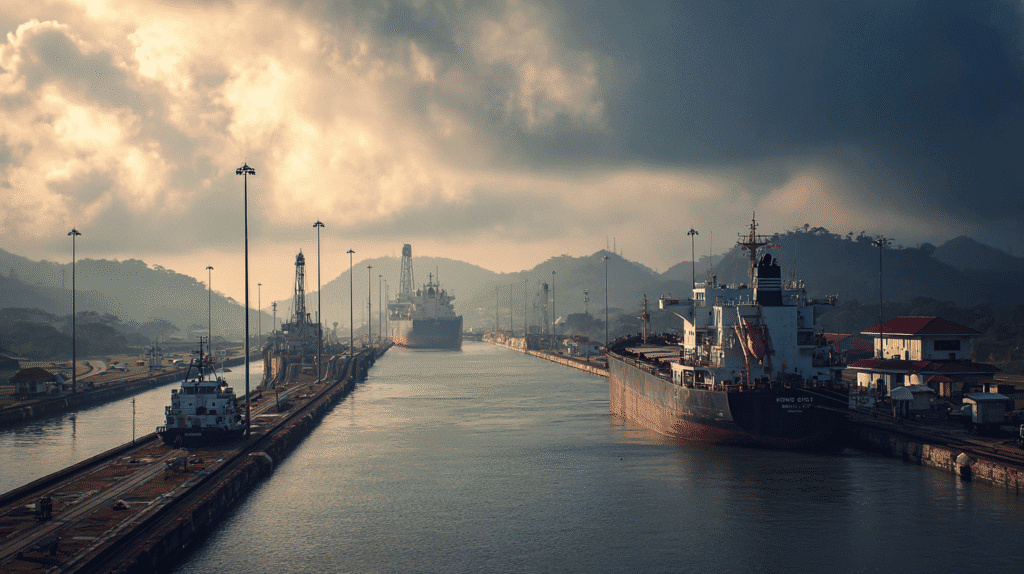
Lock engineering represented the project’s greatest innovation. The canal includes three sets of paired locks: Gatún Locks (Atlantic side), Pedro Miguel Locks, and Miraflores Locks (Pacific side). Each lock chamber measures 110 feet wide by 1,050 feet long—enormous concrete basins that fill and drain using gravity flow from Gatún Lake. Ships enter chambers, massive steel gates close behind them, water fills or drains the chamber to match the next level, forward gates open, and ships proceed.
The locks’ scale and precision amazed contemporaries. Each pair required millions of tons of concrete, steel gates weighing up to 730 tons, and machined mechanical systems operating with minimal friction despite massive forces. The gates still operate reliably over a century later, testimony to engineering quality and maintenance programs. Original electric locomotives, called “mules,” still guide ships through locks, preventing them from striking walls.
Conquering Disease and Geography
Medical breakthroughs proved as critical as engineering innovations. William Gorgas, chief sanitation officer, implemented aggressive mosquito control—eliminating standing water, fumigating buildings, installing screens, and draining swamps—reducing yellow fever and malaria transmission dramatically. This public health campaign allowed the project to proceed where disease had defeated the French attempt.
Excavating the Culebra Cut (now Gatún Cut) through the continental divide required removing over 200 million cubic yards of material—more than three times engineers initially estimated. Unstable geology caused repeated landslides as excavation destabilized slopes. Spoil trains running on temporary rail tracks removed excavated material constantly, while steam shovels worked day and night. Some areas were excavated multiple times as landslides refilled earlier excavations.
Creating Gatún Lake by damming the Chagres River provided water supply for lock operations while reducing excavation requirements. At completion, Gatún Lake was the world’s largest artificial lake, demonstrating how massive hydraulic engineering could reshape landscapes. The dam itself, constructed primarily from excavation spoil, used innovative techniques for building on soft alluvial soil.
Modern Expansion and Continuing Relevance
The original locks, completed in 1914, accommodate ships up to 965 feet long and 106 feet wide—sufficient for most vessels of that era but too small for modern “Post-Panamax” container ships and tankers. A massive expansion completed in 2016 added a third, larger set of locks accommodating ships nearly 1,400 feet long and 180 feet wide, nearly tripling cargo capacity and allowing passage of 99% of the world’s fleet.
The canal generates substantial revenue for Panama while remaining central to global shipping—roughly 5% of global trade passes through it annually. Its continued operation and expansion demonstrate how strategic infrastructure investments provide returns across generations.
Golden Gate Bridge: Elegance and Resilience in a Challenging Environment
San Francisco, California, United States
Spanning the Golden Gate strait connecting San Francisco Bay to the Pacific Ocean, the Golden Gate Bridge stands as perhaps the world’s most recognizable bridge. Completed in 1937 during the Great Depression, its 4,200-foot (1,280-meter) main span was the longest suspension span globally until 1964, while its total length of 1.7 miles (2.7 kilometers) made it an engineering landmark.
Overcoming Natural Obstacles
The bridge site presented formidable challenges: strong ocean currents flowing through the strait twice daily with tidal changes, persistent high winds accelerating through the narrow passage, frequent fog reducing visibility, deep water over 300 feet at the location requiring bridge tower foundations, and seismic activity from the nearby San Andreas Fault system.
Chief engineer Joseph Strauss initially proposed a hybrid cantilever-suspension design, but consulting engineers Irving Morrow and Charles Ellis refined it into the elegant suspension bridge built. The design’s aerodynamics received intensive study following the 1940 Tacoma Narrows Bridge collapse (which occurred after Golden Gate completion but informed retrofit evaluations). The Golden Gate’s stiffening truss design and open roadway grating allow wind to pass through rather than creating lift forces that might induce dangerous oscillations.
Tower foundations required innovative underwater construction. The San Francisco tower foundation, built relatively close to shore, used a massive concrete fender protecting the construction site from waves while workers excavated to bedrock. The Marin County tower foundation, in deeper water with stronger currents, pushed construction technology limits. Engineers used explosive charges to remove unsuitable material, then constructed a massive concrete foundation underwater using specially formulated concrete that cured even when submerged.
The bridge’s distinctive International Orange color wasn’t merely aesthetic. The orange-red hue provides visibility through fog—critical for maritime and aerial navigation—while complementing the natural surroundings better than standard gray or black. The color requires constant maintenance; painting crews work continuously, and by the time they finish one end, the opposite end needs repainting.
Seismic Retrofitting
The bridge was built before modern seismic engineering principles were established. While the original design possessed inherent earthquake resistance through its flexible suspension system, improved understanding of seismic hazards prompted major retrofit programs. Upgrades completed in the 1990s and 2000s strengthened tower foundations, replaced portions of the roadway with more earthquake-resistant materials, and installed dampers absorbing seismic energy.
These retrofits ensure the bridge can withstand major earthquakes without collapse, maintaining its role as a critical transportation link for the Bay Area. The combination of original engineering excellence and modern seismic upgrades allows this 1930s-era bridge to meet contemporary safety standards.
Cultural Icon and Engineering Inspiration
Beyond its engineering significance, the Golden Gate Bridge became an internationally recognized symbol of San Francisco and American innovation. Its graceful lines, vibrant color, and dramatic setting make it perhaps the world’s most photographed bridge. The structure appears in countless films, photographs, and artworks, transcending its functional purpose to become a cultural landmark.
The bridge’s construction during the Great Depression provided thousands of jobs while demonstrating that ambitious public works could proceed despite economic hardship. Its success inspired confidence in large-scale infrastructure investment and proved that American engineering could achieve world-leading accomplishments.
Sydney Opera House: Sculptural Architecture Pushing Structural Boundaries
Sydney, Australia
The Sydney Opera House represents one of the 20th century’s most daring architectural and structural achievements. Danish architect Jørn Utzon’s winning competition design in 1957 proposed a building unlike anything previously constructed: a series of massive, interlocking shell structures suggesting billowing sails or seashells rising dramatically from Sydney Harbour.
Geometric and Structural Complexity
Utzon’s original design presented shells with complex double-curved geometries that defied construction with available techniques. The shells weren’t merely decorative—they formed the building’s actual roof structure, requiring them to be both visually striking and structurally sound. Early attempts to rationalize the geometry for construction failed repeatedly, creating cost overruns and delays that nearly killed the project.
The breakthrough came when Utzon realized all shells could be constructed as segments of a single sphere. This “spherical solution” meant every shell section followed curves from a sphere 246 feet (75 meters) in diameter. This geometric consistency allowed each precast concrete rib to be cast using repeated formwork, dramatically reducing complexity and cost. The ribs, like slices of an orange, radiate from common centers and support precast roof panels creating the final shell surfaces.
Structural engineering by Ove Arup and Partners transformed Utzon’s artistic vision into buildable reality. The shells aren’t continuous surfaces but rather frameworks of precast concrete ribs supporting precast concrete panels covered in ceramic tiles. Each shell consists of multiple ribs, some weighing up to 15 tons, assembled using innovative post-tensioning techniques. High-strength steel cables running through ribs were tensioned after assembly, pulling elements tightly together and allowing the structure to act as unified systems rather than individual components.
The podium structure supporting the shells presented its own challenges. Built on Bennelong Point, the site required extensive foundation work stabilizing ground and providing sufficient strength for the massive shells. The podium houses rehearsal spaces, dressing rooms, theaters, and other facilities, while its broad stairs and forecourt create public spaces integrated with the harbor setting.
Construction Innovation and Controversy
The project’s complexity, cost overruns, and political controversy led to Utzon’s resignation in 1966 before completion. Australian architects finished the interiors with substantial changes from Utzon’s vision—a source of lasting regret and controversy. The building finally opened in 1973, a decade behind schedule and 14 times over original budget.
Despite construction difficulties, the completed Opera House achieved Utzon’s vision of a building appearing to float above the harbor, its white shells catching light and creating ever-changing visual effects. The structure transformed Sydney’s skyline while demonstrating how architectural ambition and engineering capability could create something genuinely unprecedented.
Lasting Impact
The Sydney Opera House influenced global architecture by proving that complex, sculptural buildings could be engineered and constructed despite enormous technical challenges. Modern computational design and fabrication techniques descended partly from innovations developed for the Opera House, making today’s parametric architecture possible.
UNESCO designated it a World Heritage Site in 2007, recognizing it as a masterpiece of 20th-century architecture and engineering—a rare honor for a relatively recent building. The structure hosts over 1,500 performances annually, fulfilling its functional purpose while remaining one of the world’s most recognizable and photographed buildings.
Hoover Dam: Depression-Era Engineering Ambition Harnessing the Colorado River
Nevada-Arizona Border, United States
Rising 726 feet (221 meters) above the Colorado River, Hoover Dam represents one of America’s greatest civil engineering achievements. Completed in 1936 during the Great Depression, the massive concrete arch-gravity dam created Lake Mead, provides water to millions across the Southwest, generates hydroelectric power for Nevada, Arizona, and California, and controls flooding that previously devastated downstream communities.
Unprecedented Scale and Challenge
When construction began in 1931, Hoover Dam was the largest concrete structure ever attempted. The dam required 3.25 million cubic yards of concrete—enough to build a two-lane highway from San Francisco to New York. Pouring such massive amounts of concrete created seemingly insurmountable challenges: concrete generates heat as it cures through chemical reactions, and engineers calculated that a single monolithic pour would take 125 years to cool completely, with the internal heat causing cracking that would destroy the structure.
The solution involved pouring concrete in blocks—columns of individual sections interlocking like massive building blocks. Rather than one continuous pour, workers poured separate blocks roughly 25 feet square and 5 feet high, allowing each section to cool before the next was poured above it. Embedded pipes circulated refrigerated water through curing concrete, extracting heat and reducing curing time to under two years. This cooling system used ammonia refrigeration plants—the largest refrigeration operation in existence at the time—circulating ice-cold water through 582 miles of steel pipe embedded in the concrete.
Foundation preparation required diverting the Colorado River—itself a major engineering challenge. Workers drilled four diversion tunnels through canyon walls, each 56 feet (17 meters) in diameter and up to 4,000 feet long. The river flowed through these tunnels while workers excavated to bedrock in the former riverbed, removing all loose material until they reached solid rock capable of supporting the dam’s enormous weight. The tunnels were later plugged and incorporated into the dam’s outlet works, used for releasing water downstream and generating power.
Construction Innovations and Human Cost
Building in the Black Canyon’s remote location, extreme heat (summer temperatures exceeding 120°F), and aggressive schedule demanded extraordinary logistics. A company town—Boulder City—was constructed to house 5,000 workers and their families. Materials arrived by specially constructed railroad. The federal government guaranteed contracts enabling private contractors to obtain financing during the Depression’s worst years.
Worker safety was systematically neglected by modern standards. Official records list 96 construction deaths, though actual numbers were likely higher. Heat stroke, falls, tunnel collapses, and falling objects killed workers regularly. The “high scalers” who rappelled down canyon walls removing loose rock worked without adequate safety equipment, suffering numerous injuries and fatalities. Labor disputes over conditions and pay led to strikes, though the Depression’s dire employment situation limited workers’ leverage.
Despite human costs, the dam’s completion provided hope during America’s bleakest economic period. The massive employment, advanced engineering, and rapid construction demonstrated American capability and resolve. The dam became a symbol of national achievement, attracting millions of visitors as a monument to Depression-era determination.
Engineering Design Excellence
Hoover Dam combines two structural types: an arch dam curving upstream, transferring water pressure to canyon walls through arch action, and a gravity dam using its mass to resist water pressure. This hybrid design optimizes material usage—the arch carries substantial load, reducing required concrete while the gravity component provides stability. The dam’s distinctive curved profile isn’t merely aesthetic but structurally optimal for the site’s geology and loadings.
Hydroelectric generation was integral to the design. Seventeen generators produce over 4 billion kilowatt-hours annually, powering over a million homes. Power revenues helped repay construction costs while providing electricity critical for Southwest development. The powerhouse at the dam’s base, with its Art Deco design and massive generators, remains operational with upgraded equipment.
Lake Mead, the reservoir created by the dam, stores up to 9.3 trillion gallons—two years’ average Colorado River flow. This storage allowed downstream development by guaranteeing water supplies even during droughts. However, prolonged drought and increased demand have reduced Lake Mead to historic lows, raising questions about long-term sustainability of Southwest water use.
Millau Viaduct: Elegance at Extraordinary Height
Millau, France
Completed in 2004, the Millau Viaduct crosses the Tarn River valley in southern France with a grace that belies its extraordinary dimensions. The cable-stayed bridge’s roadway stands up to 890 feet (270 meters) above the valley floor, while its tallest mast reaches 1,125 feet (343 meters)—taller than the Eiffel Tower—making it one of the world’s tallest structures and the tallest bridge.
Cable-Stayed Design Achieving Unprecedented Height
Unlike suspension bridges using continuous cables draped over towers, cable-stayed designs support roadways directly with cables running from towers to deck. This system provides exceptional stiffness while using less material than suspension designs, though typically spanning shorter distances. The Millau Viaduct’s central span of 1,122 feet (342 meters) and total length of 1.6 miles (2.46 kilometers) pushed cable-stayed engineering to new extremes.
British architect Norman Foster and French structural engineer Michel Virlogeux created a design emphasizing elegance and minimal visual impact despite the bridge’s scale. The slender concrete deck, supported by seven masts ranging in height depending on valley topography, appears almost to float above the valley. White masts and cables contrast against the landscape, creating visual lightness despite supporting immense loads.
Construction methodology involved both traditional pier construction and innovative launching techniques. Workers built massive concrete piers from valley floor foundations using conventional methods, while the steel-concrete composite deck was assembled on the plateaus at either end and pushed forward across completed spans. Hydraulic systems slid the deck forward progressively, cantilevering out from completed sections until reaching the next pier. This launching technique allowed construction without valley-floor scaffolding, reducing environmental impact and construction time.
Wind Engineering and Stability
The viaduct’s height exposes it to powerful wind forces. Extensive wind tunnel testing refined aerodynamic characteristics, ensuring the bridge remains stable in winds exceeding 130 mph (210 km/h)—far beyond typical operating conditions. The deck’s streamlined cross-section and split roadway configuration minimize wind forces and prevent aerodynamic instability like the resonances that destroyed the Tacoma Narrows Bridge.
Expansion joints accommodate temperature-induced movements. Steel expands and contracts with temperature changes, and the bridge’s 1.6-mile length means even small thermal expansion coefficients translate into several feet of movement. Sophisticated joints allow this movement while maintaining smooth driving surfaces, challenging given the structure’s height and exposure to temperature extremes.
The bridge transformed a bottleneck on the route from Paris to Barcelona, replacing a twisting descent into Millau and subsequent climb out. Travel time decreased by an hour while safety improved dramatically. Yet the viaduct’s impact transcends transportation efficiency—it became a destination itself, with viewing areas and visitor centers attracting tourists fascinated by its engineering elegance.
Petronas Towers: Cultural Expression Through Structural Innovation
Kuala Lumpur, Malaysia
When completed in 1998, the Petronas Twin Towers claimed the title of world’s tallest buildings at 1,483 feet (452 meters), holding it until 2004. Beyond height, the towers represent how modern engineering can express cultural identity while pushing structural limits.
Cultural Geometry Meets Modern Engineering
Argentine-American architect César Pelli designed towers with floor plans based on Islamic geometric patterns—two overlapping squares rotated 45 degrees with small circles between, creating distinctive eight-pointed star shapes with rounded corners. This geometry, traditional in Islamic art and architecture, posed significant structural challenges when extended vertically through 88 floors.
The structural system uses high-strength reinforced concrete rather than steel skeletons typical of American skyscrapers. This choice reflected Malaysian construction expertise with concrete, local material availability, and desire to demonstrate that Asian engineering could achieve world-leading heights using regional approaches. The towers’ concrete strength—reaching 80 megapascals (11,600 psi)—exceeded requirements for most construction, carefully formulated to achieve necessary strength while remaining workable during placement.
The towers’ distinctive skybridge connecting them at floors 41-42 serves multiple purposes: architectural signature, evacuations route providing escape from one tower to the other during emergencies, and structural damper reducing wind-induced motion. The bridge doesn’t rigidly connect towers but rather rests on sliding bearings, allowing towers to sway independently rather than transmitting forces between them—an innovative solution balancing connection and structural independence.
Wind Loading and Stability
Kuala Lumpur’s tropical location brings intense thunderstorms with powerful, unpredictable winds. The towers’ height, slenderness, and complex geometry created challenging wind loading conditions. Wind tunnel studies using scale models in turbulent airflow examined how wind forces varied around the irregular perimeter, identifying potential areas of high pressure or suction that might compromise cladding.
The towers’ tuned mass dampers—large weights on springs or pendulums installed near top floors—counteract wind-induced motion. As wind pushes towers in one direction, dampers swing in opposition, their mass and momentum reducing overall building movement. These systems keep tower sway within comfortable limits for occupants, who would otherwise notice and feel disconcerted by perceptible motion during windstorms.
Foundation design required anchoring towers to bedrock through variable geology. While bedrock lay relatively close to surface on one tower site, the other required deeper foundations. This asymmetry demanded careful engineering ensuring both towers achieved identical structural performance despite different geological conditions. The massive reinforced concrete raft foundations, over 15 feet thick, distribute building loads to underlying soil and rock.
Symbolic Significance
The Petronas Towers embodied Malaysia’s rapid development and ambitions for global recognition. They demonstrated that the developing world could achieve engineering feats previously monopolized by established powers. The towers anchored the Kuala Lumpur City Centre development, catalyzing urban renewal and establishing the city as a major business center.
The choice of Petronas, Malaysia’s national oil company, as anchor tenant and namesake reinforced connections between natural resource wealth, technological development, and national pride. The towers remain symbols of Islamic culture engaging successfully with modern technology and global commerce.
International Space Station: Engineering in the Ultimate Hostile Environment
Low Earth Orbit, ~250 miles altitude
The International Space Station (ISS) represents humanity’s most ambitious engineering project conducted in space. Orbiting Earth every 90 minutes at 17,500 mph, the station provides a permanently inhabited research laboratory where international crews conduct experiments impossible on Earth. Completed through contributions from NASA (United States), Roscosmos (Russia), ESA (European Space Agency), JAXA (Japan), and CSA (Canada), the ISS demonstrates unprecedented international engineering cooperation.
Assembly in Space
Unlike Earth-based structures, the ISS couldn’t be built in a factory and shipped complete—it required assembly in orbit from modules launched separately over 13 years (1998-2011). Each module arrived via Space Shuttle or Russian rockets, was captured by robotic arms or docked autonomously, then connected to existing structures. Spacewalking astronauts performed much of the assembly, connecting electrical systems, fluid lines, data cables, and structural elements in environments where mistakes could prove fatal.
The completed ISS spans 357 feet (109 meters) from end to end—larger than a football field—with pressurized volume equivalent to a six-bedroom house. Its mass exceeds 450 tons, making it the largest object humans have assembled in space. The modular design allows damaged or outdated components to be replaced, extending operational life potentially for decades.
Life support systems provide breathable air, potable water, and waste management in an environment completely isolated from Earth’s biosphere. The station generates oxygen by electrolyzing water (splitting it into hydrogen and oxygen using electricity), scrubs carbon dioxide from air using chemical reactions, and recycles wastewater—even urine—back into drinking water through advanced filtration. These closed-loop systems minimize resupply requirements, though regular cargo missions still deliver food, research equipment, and spare parts.
Surviving the Space Environment
Space presents engineering challenges Earth-based structures never face. The ISS experiences extreme temperature swings—over 250°F (120°C) in direct sunlight, below -250°F (-157°C) in Earth’s shadow—cycling between these extremes every 90 minutes as it orbits. Thermal control systems using radiators, heaters, and carefully designed insulation maintain interior temperatures while dissipating heat generated by equipment and crew.
Micrometeorite impacts and space debris threaten the station constantly. While tracking systems monitor larger debris, countless small particles strike the station regularly at speeds exceeding 15,000 mph. Critical modules include reinforced shielding using multiple layers of different materials that fragment and vaporize impacting particles. Despite precautions, small impacts occasionally penetrate, requiring repairs or module isolations.
Radiation exposure from cosmic rays and solar activity creates health risks for crews and damages electronics. The station’s orbit through Earth’s magnetosphere provides some protection, but radiation levels far exceed Earth’s surface. Shielding, radiation-resistant electronics, and limiting crew mission duration mitigate but don’t eliminate risks.
Attitude control keeps the station properly oriented—solar panels facing the sun for power generation, modules positioned correctly for docking, communication antennas aimed at relay satellites. Control moment gyroscopes—rapidly spinning wheels that can be tilted to transfer momentum—adjust station orientation without consuming propellant, while periodic thruster firings maintain proper orbital altitude as atmospheric drag gradually slows the station.
Scientific Capabilities
The ISS provides a microgravity environment enabling experiments impossible on Earth. Researchers study materials science, combustion physics, fluid dynamics, biology, and medicine under conditions where gravity’s influence becomes negligible. Crystal growth experiments produce larger, more perfect crystals than Earth-based methods allow. Combustion studies reveal flame behaviors hidden by buoyancy-driven flows on Earth. Medical research examines how extended weightlessness affects human physiology, informing plans for deep space exploration.
The station’s Earth observation capabilities provide unique perspectives on climate, weather, natural disasters, and environmental change. Cameras and instruments aboard the ISS monitor ocean temperatures, atmospheric composition, deforestation, urban growth, and natural phenomena, contributing valuable data to Earth science research.
International Cooperation Achievement
Perhaps the ISS’s greatest achievement isn’t technical but political—demonstrating that nations with historical rivalries could cooperate on extraordinarily complex, long-term projects. American and Russian modules interconnect seamlessly despite being designed under different engineering standards. Crew members from different nations work together continuously, sharing living quarters and conducting joint research.
This cooperation survived significant political tensions, including the 2014 Ukraine crisis that strained US-Russian relations. While cooperation occasionally frayed, the ISS partnership persisted, showing how shared scientific goals can transcend geopolitics. The station’s future remains uncertain beyond the late 2020s, but its legacy as proof that complex international engineering collaboration can succeed will endure.
What Makes Engineering Structures Truly Impressive
These monuments to human capability share characteristics that elevate them beyond mere technical accomplishment. Understanding what makes structures genuinely impressive clarifies what we value in engineering achievement and what future projects should strive toward.
Overcoming Unprecedented Challenges
The most impressive structures push beyond what was previously possible, solving problems never before addressed. The Burj Khalifa confronted height-related challenges no building faced before. The Channel Tunnel bored through geology beneath ocean depths. The Panama Canal conquered tropical disease and unstable terrain that defeated initial attempts. Hoover Dam poured concrete on a scale requiring entirely new techniques.
Problem-solving innovation—developing new methods, materials, or approaches when existing techniques prove inadequate—defines truly groundbreaking engineering. These structures didn’t simply apply established methods at larger scale; they required fundamental innovations making the impossible feasible.
Harmonizing Function and Beauty
The greatest structures transcend pure functionality to achieve aesthetic excellence. The Golden Gate Bridge performs its utilitarian purpose of connecting two land masses across water, but its elegant suspension design and distinctive color make it beautiful. The Millau Viaduct spans a valley with grace and apparent effortlessness despite its enormous scale. The Sydney Opera House functions as a performing arts venue while creating sculptural architecture of extraordinary beauty.
Engineering constraints often inspire rather than limit aesthetic achievement. The Burj Khalifa’s distinctive setbacks result from structural and wind engineering requirements yet create its signature profile. The Channel Tunnel’s form follows function purely—yet there’s beauty in its efficiency and precision. The most satisfying structures integrate engineering requirements with aesthetic sensibilities, neither sacrificing function for appearance nor accepting ugliness as the inevitable price of utility.
Enduring Through Time
Structures prove their greatness partly through longevity. The Great Wall stands two millennia after construction. Hoover Dam operates reliably nearly a century after completion. These structures weren’t built for temporary purposes but as permanent infrastructure serving generations.
Durability requires understanding materials, environment, and maintenance. Engineers designing truly impressive structures consider not just initial construction but decades or centuries of operation, environmental exposure, and eventual deterioration. They select materials carefully, incorporate maintenance accessibility, and design for repair and adaptation as conditions change.
Modern structures face challenges their historical counterparts didn’t—technological obsolescence means a building’s mechanical systems, elevators, or telecommunications infrastructure may require replacement long before structural elements fail. Successful contemporary structures allow such updates without complete reconstruction.
Enabling Human Flourishing
The most meaningful structures improve lives, connect communities, enable economic development, or expand human capability. The Panama Canal transformed global trade. The Channel Tunnel united Britain and continental Europe more closely. Hoover Dam provided water, power, and flood control enabling Southwest development. The ISS extends human presence beyond Earth while producing scientific knowledge.
Engineering’s ultimate purpose isn’t creating impressive objects but serving human needs. While technical excellence and aesthetic beauty matter, structures prove their worth by making lives better, safer, more prosperous, or more connected. Engineering serves humanity—the best structures embody this purpose clearly.
Inspiring Future Generations
Truly impressive structures kindle imagination and inspire people to pursue engineering, science, and ambitious goals. Children seeing the Golden Gate Bridge or visiting Hoover Dam dream of building similar marvels. Students learning about the ISS envision careers in space exploration. These structures demonstrate what humans can achieve, encouraging future generations to attempt even greater accomplishments.
This inspirational impact extends beyond engineering—impressive structures remind us of human capability generally, providing hope during difficult periods and demonstrating that collaboration, creativity, and persistence can solve seemingly impossible problems.
The Future of Engineering Structures
As technology advances and human ambitions evolve, what structures might future generations build?
Kilometer-High Buildings
Multiple proposals aim to exceed one kilometer (3,280 feet) in height—including the Jeddah Tower in Saudi Arabia (currently under construction, designed to exceed 1,000 meters). These supertall structures will require innovations beyond those developed for the Burj Khalifa, including advanced damping systems, revolutionary elevator technologies, and materials strong enough yet light enough for such heights.
Megascale Infrastructure
China’s massive infrastructure investments include bridges spanning valleys with world-record dimensions, high-speed rail networks connecting entire nations, and proposed projects like tunnels beneath ocean straits. These projects demonstrate that scale alone continues pushing boundaries—longer, taller, and faster remain engineering frontiers.
Space Infrastructure
Beyond the ISS, proposals include commercial space stations, lunar bases, Mars habitats, and orbital manufacturing facilities. Space-based solar power stations, asteroid mining infrastructure, and eventually interplanetary transportation systems will require engineering in environments even more hostile than low Earth orbit, solving challenges around radiation, long-term life support, and resource utilization without Earth’s support.
Climate-Responsive Infrastructure
As climate change accelerates, engineering must address rising seas, extreme weather, and resource scarcity. Floating cities, massive flood barriers protecting coastal metropolises, carbon capture facilities, renewable energy infrastructure at unprecedented scale, and water desalination and distribution systems will define 21st-century engineering challenges. These structures will prove impressive not through height or span but through solving humanity’s most pressing environmental problems.
Digital Integration
Future structures will integrate digital systems from inception, using sensors monitoring structural health, AI optimizing operations, and robotics performing maintenance. “Smart” buildings and infrastructure adapting to usage patterns, environmental conditions, and occupant needs will transform how we conceive of static structures, making them dynamic, responsive systems.
Conclusion: Engineering as Human Expression
The world’s most impressive engineering structures represent more than concrete, steel, and technical specifications. They embody human creativity confronting physical constraints, innovation overcoming seemingly insurmountable obstacles, and collaborative effort achieving what individuals cannot. They connect us across geography—bridges linking separated lands, tunnels burrowing beneath barriers, canals creating shortcuts through continents. They provide shelter, enable commerce, generate power, and extend human reach into realms previously inaccessible.
These structures remind us of our capacity for greatness. When facing challenges that seem overwhelming—whether personal struggles or civilizational threats—these monuments demonstrate that humans can achieve extraordinary things through vision, persistence, cooperation, and ingenuity. The engineers who designed them, workers who built them, and societies that supported them often confronted doubts, setbacks, and critics insisting their goals were impossible. Yet they persevered, and their creations still serve, still inspire, and still demonstrate what becomes possible when we dare to attempt the extraordinary.
As we confront the 21st century’s challenges—climate change, resource limitations, growing populations, and the eternal human drive to explore and create—we’ll need engineering that matches or exceeds these historical achievements. The structures we build today and tomorrow will similarly demonstrate our values, capabilities, and vision. Whether we’re remembered for addressing our most pressing challenges or for continuing to push boundaries of what’s possible, our engineering legacy will speak of who we were and what we believed humans could accomplish.
The most impressive engineering structures ultimately tell us something profound: that human imagination constrained only by physical laws and human determination can quite literally move mountains, span seas, and reach for the stars.